Private pool villas in Bali: what to check before you rent
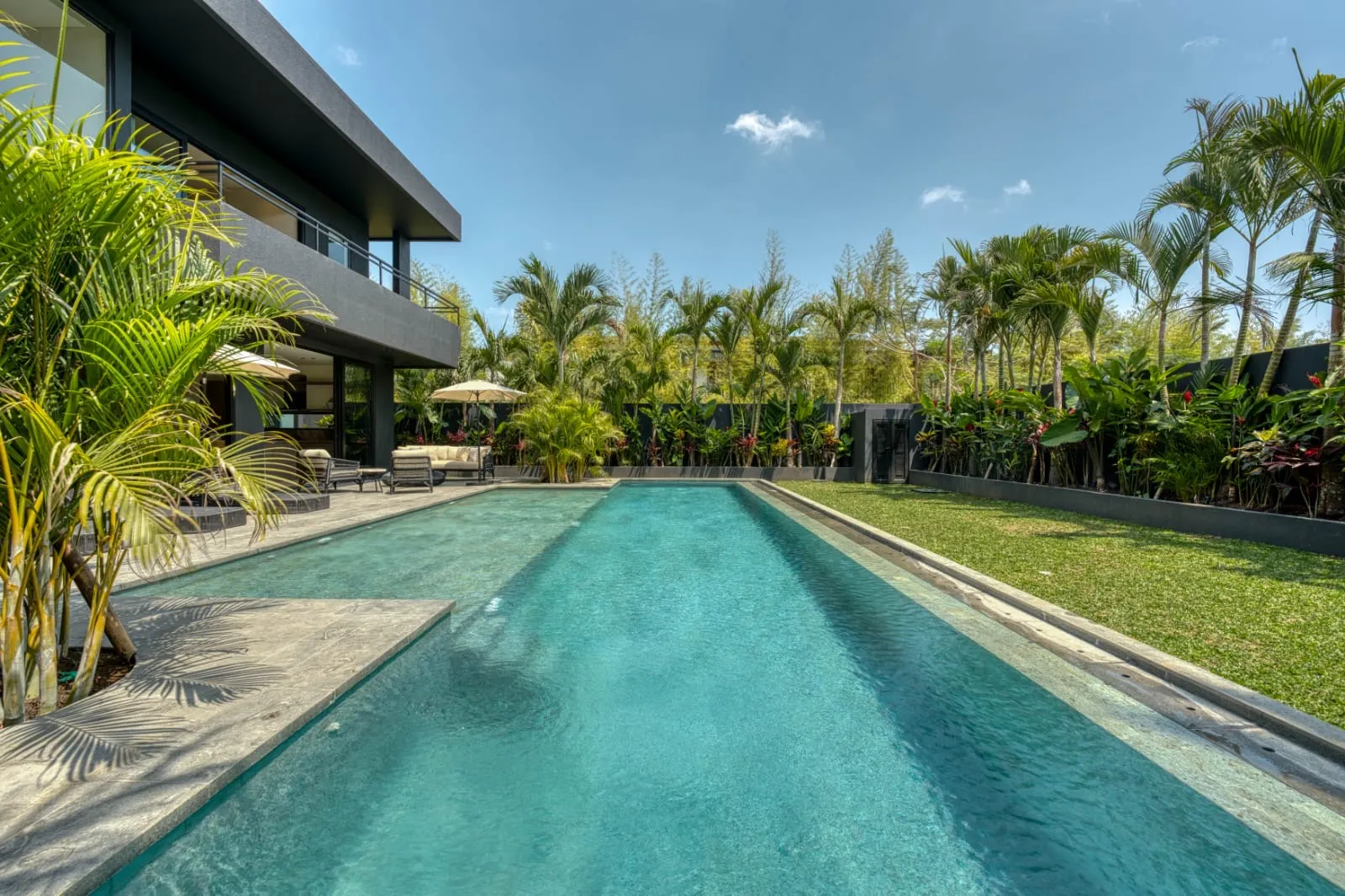
A pool looks the same in every listing photo. The differences between two villas show up once you live there: who looks after it, what it adds to your monthly bills, and whether your children can play near it safely. Before you sign for a private pool villa in Bali, spend twenty minutes on the checks below.
Who cleans the pool, and how often
In a tropical climate, leaves fall in every day and the water warms up fast, so a pool left alone for a week turns green. Ask the owner or manager three simple questions: who comes, how often, and whether chemicals are part of the deal.
A villa listings site that covers Bali, Bali Villa Hub, describes a typical routine. The pump runs about 8 to 12 hours a day. Someone skims the surface daily, brushes and vacuums about once a week, and tests and adjusts the water 2 to 3 times a week. The filter is backwashed or the cartridge cleaned every 10 to 14 days. Target values are a pH of about 7.2 to 7.6 and chlorine at about 1 to 3 ppm. The same page says pool care is often included in Bali rentals, but not always, and the scope varies from one villa to another.
When it is not included, you hire someone yourself. One agency listing for a three-bedroom villa in Kerobokan estimates pool maintenance at Rp 500,000 to 700,000 a month (Bali Home Immo). That is one agency’s estimate for one villa. We found no published price list from a Bali pool company, so ask two or three of them for a written quote that states the number of visits a week and whether chemicals are included.
A few things to ask during the visit:
- Is there a written schedule for the pool person, and who do you call if the water turns cloudy?
- Are chlorine and other chemicals included, or billed to you?
- Who pays for a broken pump or a leak?
- Is the pool chlorine or salt? A salt pool still uses chlorine, made on site by a generator from the salt, so it is not chemical-free (Poolonomics).
Safety around a private pool with children
The World Health Organization’s 2024 global report on drowning counted about 300,000 drowning deaths in 2021, a quarter of them among children under 5, and found that 86% of countries have no law requiring fences around swimming pools (WHO). In practice, many villa pools in Bali open straight onto the living room or the terrace.
A US children’s hospital, Nationwide Children’s, says studies suggest a fence could prevent about half of child pool drownings. Its guidance is concrete: a fence on all four sides that separates the pool from the house, at least 4 feet (about 1.2 m) high, with gaps under 4 inches (about 10 cm), and a gate that closes and latches by itself, with the latch out of a child’s reach. Covers and alarms help, but they do not replace a fence.
What to do in a villa without a fence:
- Ask the owner if you may install a removable pool fence for the length of your stay, and get the answer in writing.
- Check every sliding door that opens onto the pool. Can a toddler open it alone?
- Look for anything a child could climb on near the edge: loungers, planters, low walls.
- Agree on one adult who watches the water at any given moment. The same hospital page says to stay within arm’s reach of toddlers and weak swimmers, and never to let children supervise other children.
Also check the depth, whether there is a shallow step or a ladder, and how slippery the stone around the edge gets after rain. With a toddler, you will notice each of them within the first week. The pool is only one item on a parent’s list; our checklist for family villas in Bali also covers bedroom layout and the school run.
Water: what fills the pool and what you drink
Bali villas get their water in two ways. Some are on the municipal supply; others pump groundwater from a well, and the quality of well water varies with the area and with how well the system is maintained (Bali Villa Hub). The same source says Bali tap water is not reliably treated for drinking. Most villas provide bottled water or a large dispenser for drinking and brushing teeth.
So ask where the water comes from, whether there is a filter on the main supply, and who replaces the drinking water bottles. If the villa uses a well, ask how deep it is and when the water was last tested. The answers matter for the showers and the kitchen as much as for the pool.
The real monthly cost of a pool villa
The pump uses electricity every day, and in most long-stay leases the tenant pays the electricity bill. For homes connected at 3,500 VA and above, PLN was still charging Rp 1,699.53 per kWh in October 2026, the same rate as from July to September (Metro TV). On 5 October the energy minister said he hoped the rate would not rise for the last quarter, but no official decision for October to December had been published at that point (detik). Tariffs are reviewed every quarter, so check the current rate. Ask for the last two or three bills to see what the villa really uses, because air conditioning and the pool pump together make up most of it.
| Item | Often included? | What to ask |
|---|---|---|
| Pool cleaning | Sometimes | How many visits a week, written schedule |
| Chemicals | Varies | Included or billed separately |
| Pump repairs | Varies | Who pays for wear and breakdowns |
| Electricity for the pump | Rarely | Last bills, meter type |
| Drinking water | Usually | Bottles or dispenser, who refills |
| Pool fence | Rarely | Can you install a removable one |
Our guide to renting in Bali lists the other extras that are often charged on top of the rent. For a full household budget, including school fees and food, see the cost of living in Bali.
Checking the pool on the day you visit
Photos tell you little. A pool can be shot on its one clean day. When you visit, look at the water itself: it should be clear enough to see the floor at the deep end, without a green tint or a strong chemical smell. Look at the tiles along the waterline for black or green marks, and at the pump room for leaks or rust. Ask to see the pump running.
Ask, too, how the pool sits in relation to neighbours. In a dense street, a pool overlooked by a two-storey house next door may not feel private. Listen for noise from construction or the road at the hour you would actually swim.
If you are searching without an agent, our article on finding a Bali villa for rent explains how to check who controls the villa before you pay a deposit. The other renting guides cover leases and prices.
Villa Awana and its pool
Villa Awana is a four-bedroom villa in Dharma Residence, on Jl. Bumbak Dauh between Umalas and Berawa (Kerobokan). It has a 60 m² private pool, three bathrooms, 300 m² of living space on a 600 m² plot, and parking for two cars and four scooters. It was built in 2026 and is fully furnished.
Two of the questions above have a direct answer here. Housekeeping and pool cleaning happen every day and are fully included in the rent, and the garden is maintained too. You pay for electricity and the fibre internet. Rates include taxes and there is no agency fee: USD 10,000 a month from the first month, or USD 110,000 for a year paid upfront, which works out to about USD 9,167 a month. The deposit is one month of rent.
If you come with young children, look at the pool area during the visit and ask about the layout before you commit. The villa is managed by Celo Studio, on WhatsApp at +62 813-5937-919. Send your dates and the size of your household; visits run until 4 pm.